Saying “I’m coming!” in Japanese? Don’t use 来る.
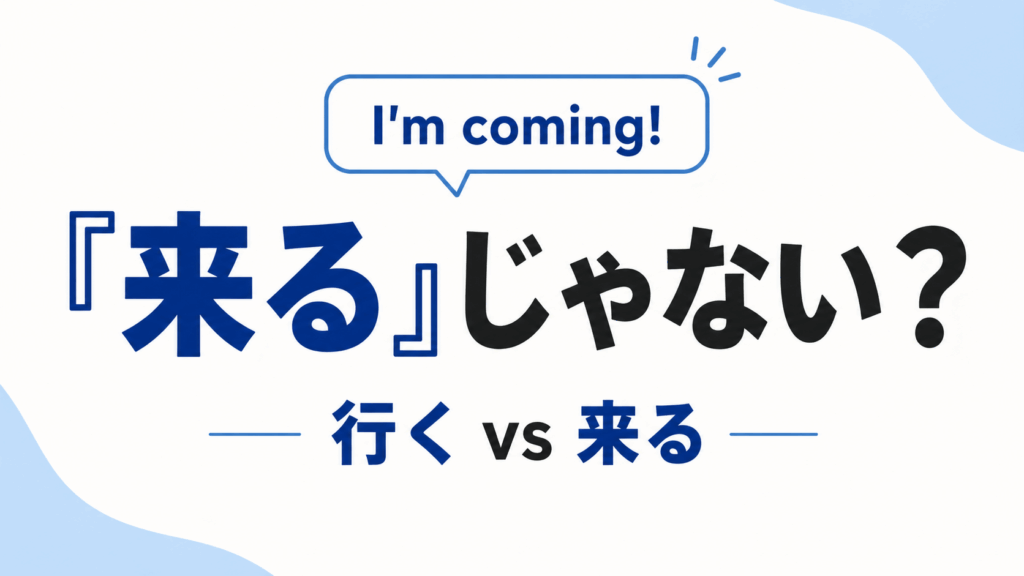
Imagine this scene:
Your mom calls from the kitchen
— “Dinner’s ready!” You shout back from your room
— 「はーい、今(いま)来(く)る!」
…wait. Is that right?
Last week, I was reading through comments in my JLPT course, and one of my students wrote something like this:
“来年(らいねん)の春(はる)、絶対(ぜったい)に日本(にほん)に来(き)ます!”
(Next spring, I’ll definitely come to Japan!)
I smiled because I knew exactly what they meant.
But it’s not quite right — and this is one of the most common mistakes English speakers make in Japanese.
Did you spot it?
In English, we say “I’m coming!” when we’re about to join someone. So it feels natural to reach for 来る in Japanese too.
But in Japanese, the rule is simpler than the English one:
行く
= movement away from where you are now
来る
= movement toward where you are now
That’s it. It doesn’t matter where the other person is. What matters is your current location.
So:
・Mom calls you for dinner
→ 「今行く!」 (you’re leaving your room)
・You’re in the US, dreaming of Japan
→ 「来年の春、絶対に日本に行きます!」
・Emailing your teacher to cancel next week’s lesson
→ 「レッスンに行けません」
If you’ve been saying 来る in situations like these, you’re not alone — this is one of the first habits English speakers need to unlearn in Japanese.
This is one of those things that’s easy to miss when you’re studying alone. You read it, you get it, and then the moment you try to use it, the English brain kicks in and “come” sneaks back.
That’s honestly why I love reading my students’ comments in the course — these little slips are where the real learning happens, and we get to fix them together, one by one.
—————
P.S. If you’d like me to catch those little slips in your Japanese too, here are the three courses where we can work together:
JLPT All-in-One Course
Everything you need to pass the exam with confidence, in just 10 minutes a day.
>>Learn more and join the waitlist
90-Day Speaking Course
Stop freezing. Start speaking. 10 minutes a day + my voice feedback.
>>Learn more and join the waitlist
90-Day Handwriting Course
Stop forgetting. Write to remember. 10 minutes a day + my red-pen feedback.
>>Learn more and join the waitlist
Curious what my students think?